
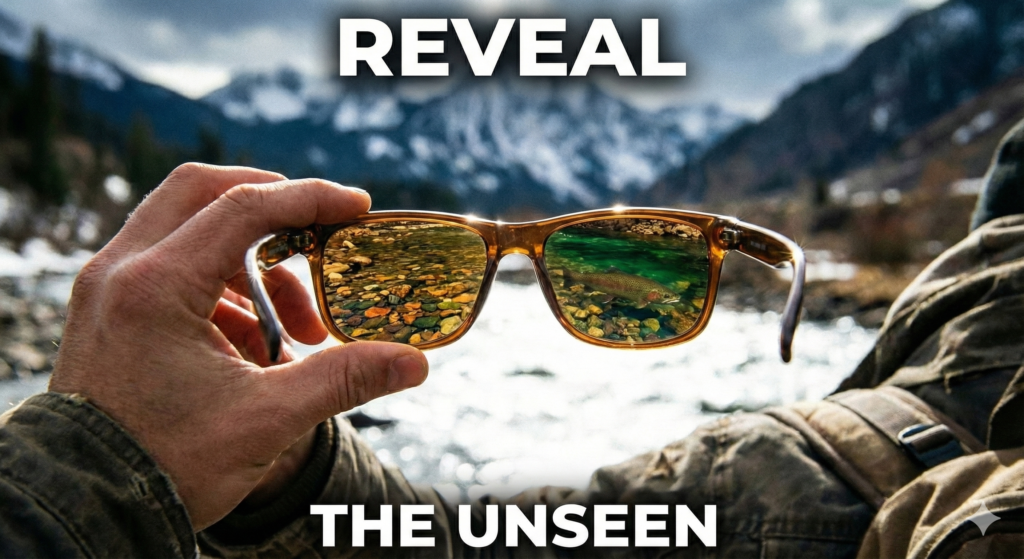
If you can read a topo map, you can master reading water for trout.
Climbers already have the instinct. When you scan a limestone wall, you don’t see a flat surface. You see lines of weakness. You spot the ledges, the cracks, and the rests.
Fly fishing in mountain streams is the same game.
The river has structure. It has “holds” where the fish hang on, and “crux moves” where the current is too fast. To catch wild fish in the high country, stop looking at the water as a liquid. Treat it as terrain.
The Physics of the River
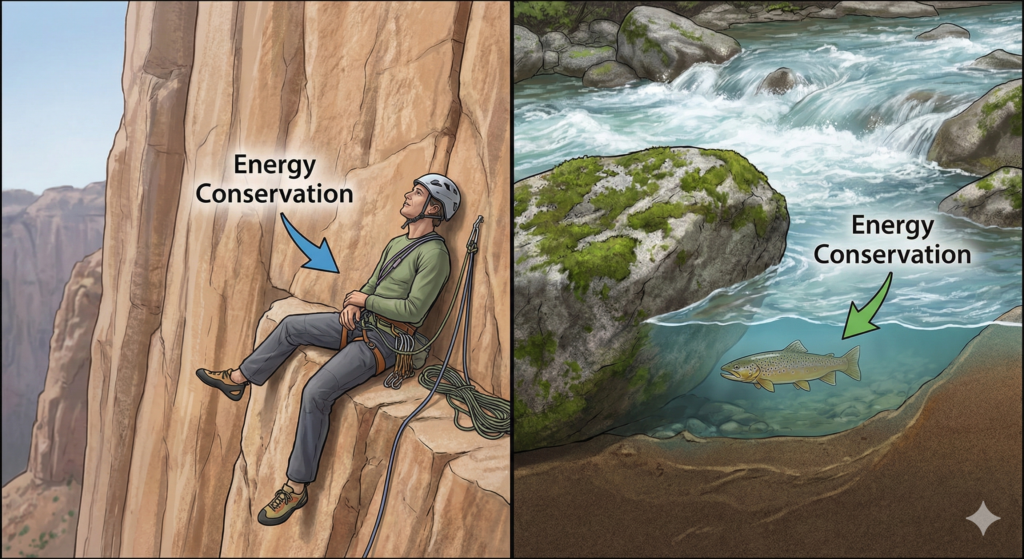
In climbing, you never hang on your muscles if you can hang on your skeleton. You find a rest to conserve energy.
A trout operates on the exact same math. They look for “Hydraulic Cushions”—places where they can sit without swimming against the full force of the treadmill.
Look for the big boulders:
- The Front Cushion: The high-pressure pillow of slow water in front of a rock.
- The Eddy: The swirling, slower water directly behind the rock.
Pro Tip: Don’t cast into the heavy whitewater. Cast into the soft pockets around the violence.
Find the Seam (The Route)
When you look up a route, you look for the crack system. In a river, this is called The Seam.
The seam is the visible line where fast water meets slow water. It looks like a crease in the surface tension or a line of bubbles. Food gets trapped in the fast conveyor belt, but the trout sits in the slow water right next to it. They tilt up, grab a bug, and sink back down. To know exactly what that food looks like, check out our guide on Alpine Fly Fishing Flies.
Your job is to float your fly right down that line. If you are two feet to the left, you are in dead water. Two feet to the right, your fly rips away too fast.
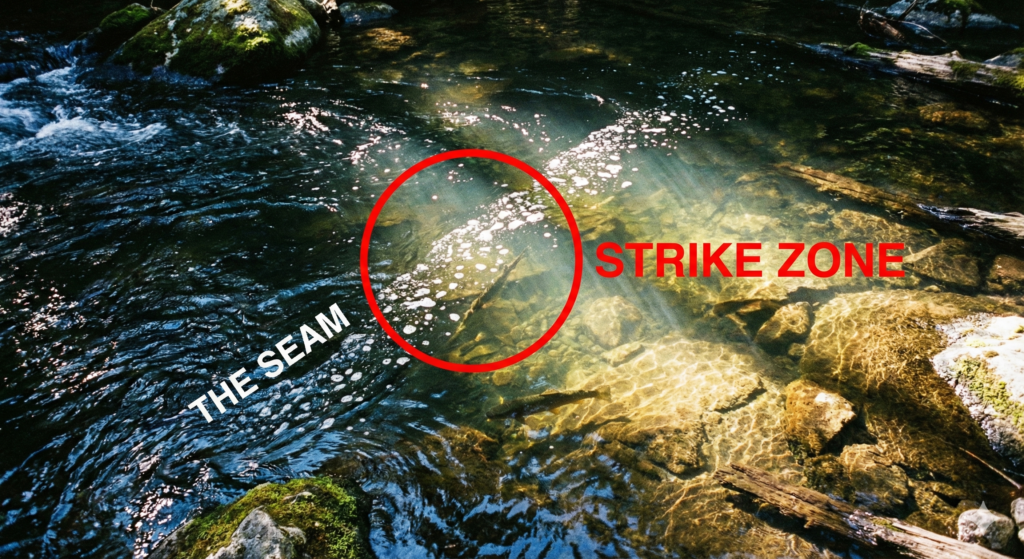
Food (bugs) gets trapped in the conveyor belt of the fast current. But the trout sits in the slow water right next to it. They treat the seam like a buffet line. They tilt up, grab a bug from the fast lane, and sink back down into the slow lane.
Your Move: Cast your fly so it floats right down that line. If you are two feet to the left, you are in dead water. Two feet to the right, your fly rips away too fast. Hit the seam.
Stealth: The Approach
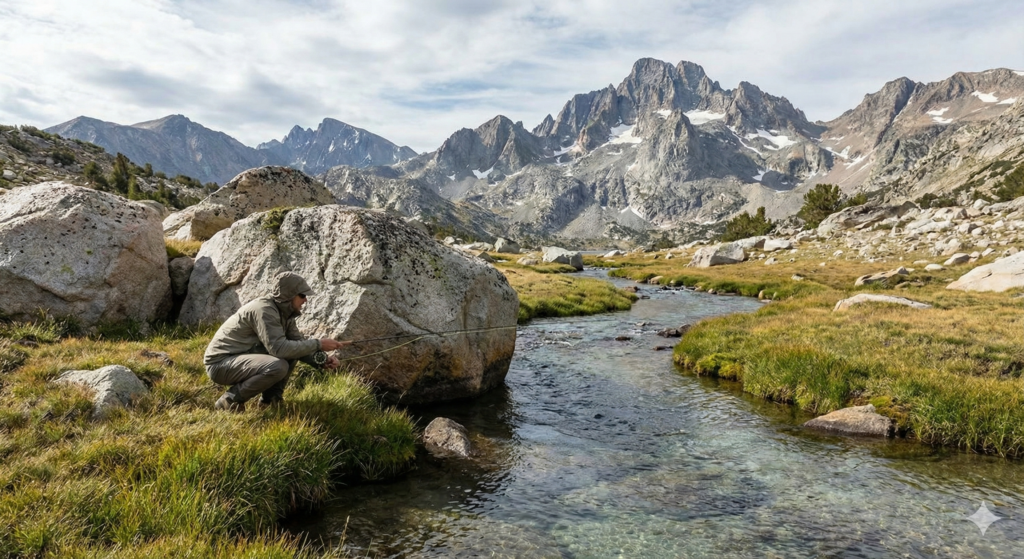
I’ve seen climbers spend twenty minutes analyzing a boulder problem before they touch the rock. Fishermen call this “The Stalk.”
In high-alpine streams, the water is gin-clear. If you stomp your feet, you send vibrations into the ground that travel instantly into the water. The fish will lock their jaws.
- Keep a low profile: Crouch down.
- Watch your shadow: If your shadow hits the water, the game is over.
Final Beta
You don’t need to be a biologist. You just need to understand physics.
Water moves around obstacles just like wind moves around a mountain. Next time you cross a stream, stop on the bridge. Practice identifying the “rests” and the seams. Once you see the structure, you’ll never look at a river the same way again.